
In short: content hub strategy is worth getting right. Here's what matters most for your situation.
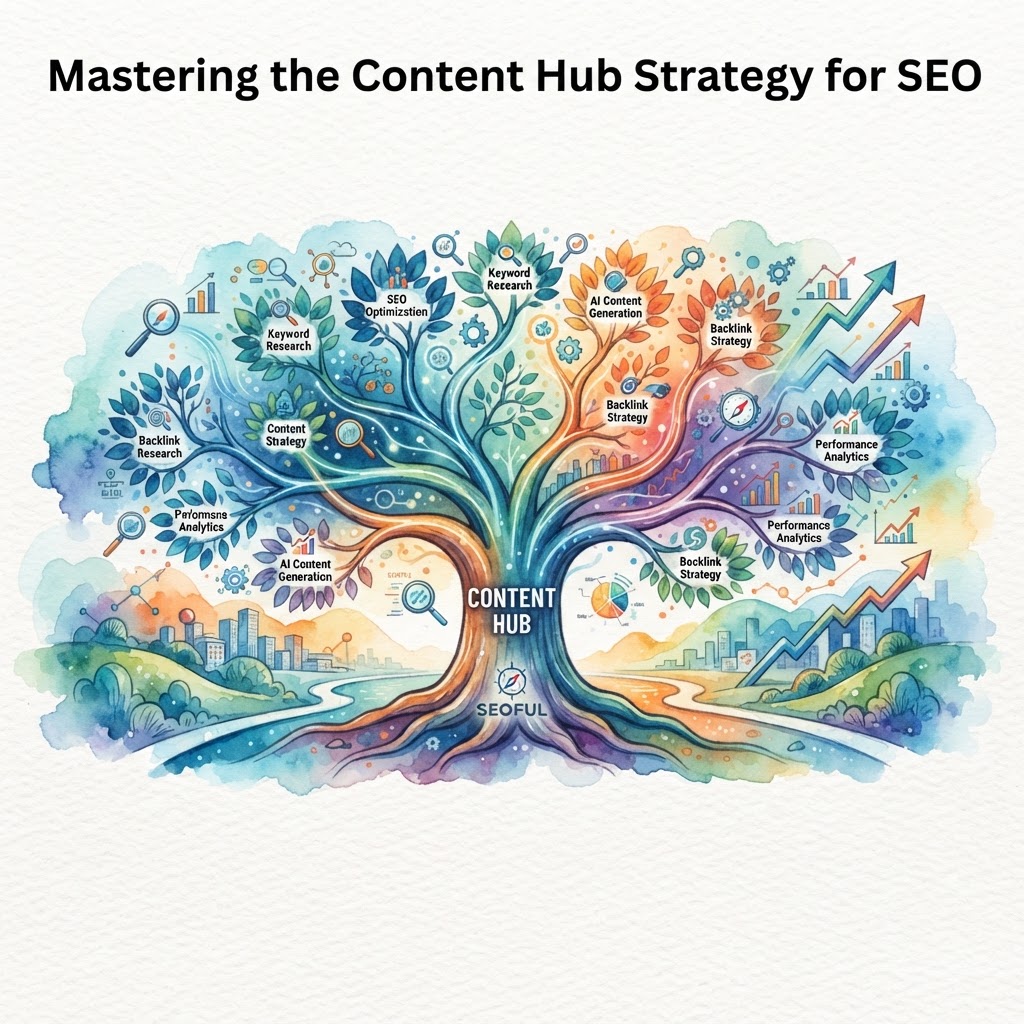
A content hub strategy is a centralized architectural framework that organizes website content into interconnected clusters around a core topic, designed to maximize topical authority and search engine rankings. At SEOFUL, our global team specializes in deploying automated, high-velocity content systems that turn disjointed pages into a dominant organic growth engine. By leveraging advanced data orchestration, we eliminate the manual bottlenecks that typically stifle enterprise-level SEO efforts.
In our experience at SEOFUL, managing a sophisticated content hub strategy manually is an inefficient use of human intelligence. We treat SEO as an engineering challenge. By replacing manual content workflows with our autonomous growth systems, we have seen agencies and startups scale their keyword footprint by over 300% in as little as six months. This is not about chasing algorithm updates; it is about building a structurally sound foundation that search engines are algorithmically designed to trust.
How Does a Content Hub Strategy Drive Organic Growth?
A content hub strategy functions by creating a central pillar page that acts as a definitive guide, supported by an array of sub-topic articles that provide deep, nuanced coverage. This structure creates a semantic web that signals to Google and other AI engines that your domain is the primary authority for that specific niche. When you automate this process, you ensure that every piece of content is perfectly linked to its parent, reinforcing the topical relevance across your entire site.
Why is Automation Essential for Modern SEO?
The complexity of maintaining a robust content hub strategy increases exponentially as you add more clusters. To maintain consistency and semantic depth, you need an automated workflow that handles internal linking, topic expansion, and content deployment simultaneously. Our platform, SEOFUL - Blog Writer, Publisher and SEO Competition Analysis, serves as the central nervous system for your SEO operations, allowing you to orchestrate massive content production without increasing your headcount.
We have found that the most successful digital agencies follow a rigorous process to build topical authority at scale, ensuring that no technical gaps exist in their content webs. You can explore how we approach this by reviewing our frameworks on building topical authority at scale. By integrating these automated systems, you shift your focus from manual keyword research to high-level strategic growth, allowing our platform to handle the heavy lifting of execution.
How Do You Implement a Content Hub Strategy at Scale?
Implementing a successful content hub strategy requires more than just high-quality writing; it demands precision, timing, and logical distribution. Most sites fail because their internal linking structure is fragmented or incomplete. To avoid this, we recommend a programmatic approach where your software dictates the structure based on real-time data, not intuition.
Consider these essential steps for executing an automated content hub strategy:
- Define Your Pillars: Use data-driven research to identify high-value core topics that represent the primary service areas of your business.
- Orchestrate Sub-topic Clusters: Use automation to generate depth-oriented articles that answer specific long-tail queries related to your pillar.
- Automate Internal Linking: Link back from every supporting article to your central hub page, strengthening the authority of the pillar. You can learn more about the mechanics of this at mastering topical authority SEO.
- Continuous Performance Review: Monitor how your content hub strategy interacts with current search engine indexing patterns to optimize for ongoing dominance.
For those looking to optimize their workflow further, our Pricing page outlines the various levels of automation we provide to suit different scales of operation. By treating your website as a programmable asset, you can effectively dominate search positions while your competitors struggle with the limitations of manual content production. According to Google’s official SEO documentation, maintaining a logical site structure is a fundamental requirement for search indexability, a task that our platform automates natively.
Why Your Current Strategy Might Be Falling Behind
The era of manual content creation is ending. If you are still relying on human writers to research, draft, and manually link hundreds of articles, you are operating at a speed that cannot compete with modern automated systems. An effective content hub strategy relies on the rapid deployment of high-relevance content—this requires a system that is always on, always optimizing, and always scaling.
At SEOFUL, we have built the tools necessary to move your SEO from a reactive task to a proactive, automated asset. By automating your content hub strategy, you ensure that your site is constantly evolving, reflecting the most up-to-date information in your industry. This constant state of renewal is what search engines prioritize today. Stop managing your SEO; start orchestrating it with a platform designed for the future of search.
FAQ
What is a content hub strategy?
A content hub strategy is a method of organizing website content into pillar pages and supporting clusters to build topical authority and improve search engine rankings. By mapping topics systematically, you ensure that your domain is seen as an expert on core subjects.
How does automation improve a content hub strategy?
Automation improves a content hub strategy by handling the repetitive tasks of internal linking, content deployment, and topical expansion at a velocity humans cannot match. This ensures your site maintains consistent structure and authority without manual intervention.
Why choose SEOFUL for your content hub strategy?
SEOFUL provides an end-to-end automated environment that integrates content creation, publishing, and SEO analysis into a single workflow. Our platform is designed specifically to help agencies and startups scale their organic reach through data-driven architectural control.